Northumberland is well known for its rich musical heritage, often described as having no rival in England for its unbroken tradition. The survival of the heritage is undoubtedly thanks in part to the Society of Antiquaries of Newcastle upon Tyne, who made it their mission ‘to protect and preserve the ancient melodies of Northumberland’ in the 1850s.[1] The result was the publication of the Northumbrian Minstrelsy – one of the first large-scale regional surveys of traditional music in England – in 1882. While this book is out of scope for the Music, Heritage, Place project, the 21 pre-1850 music items held at Northumberland Archives in the Society’s collection provide a rich exemplar of county music-making in past centuries. By examining each source and cataloguing each tune, we can offer not only further insights into Northumberland’s musical heritage but an even richer narrative of England’s music history.

Northumberland Archives is situated in Woodhorn Museum.
What does it mean to catalogue these sources?
Often county record offices lack the resources, understandably, to have specialist cataloguing of their holdings. Many of their catalogues – not all of which have made it online yet – list music with a single word, such as song, dance, tune. The Music, Heritage, Place project provides the resource and capacity to provide much more detailed information of these music holdings, both for record offices to update their catalogues but also by cataloguing every tune in each source into the free online database RISM. You can search by title, source, composer, location or even the opening notes of the tune. Let’s take an example.
The ‘College Hornpipe’ is found in many of the Northumberland manuscripts. It is better known today as the theme tune to the popular cartoon Popeye!
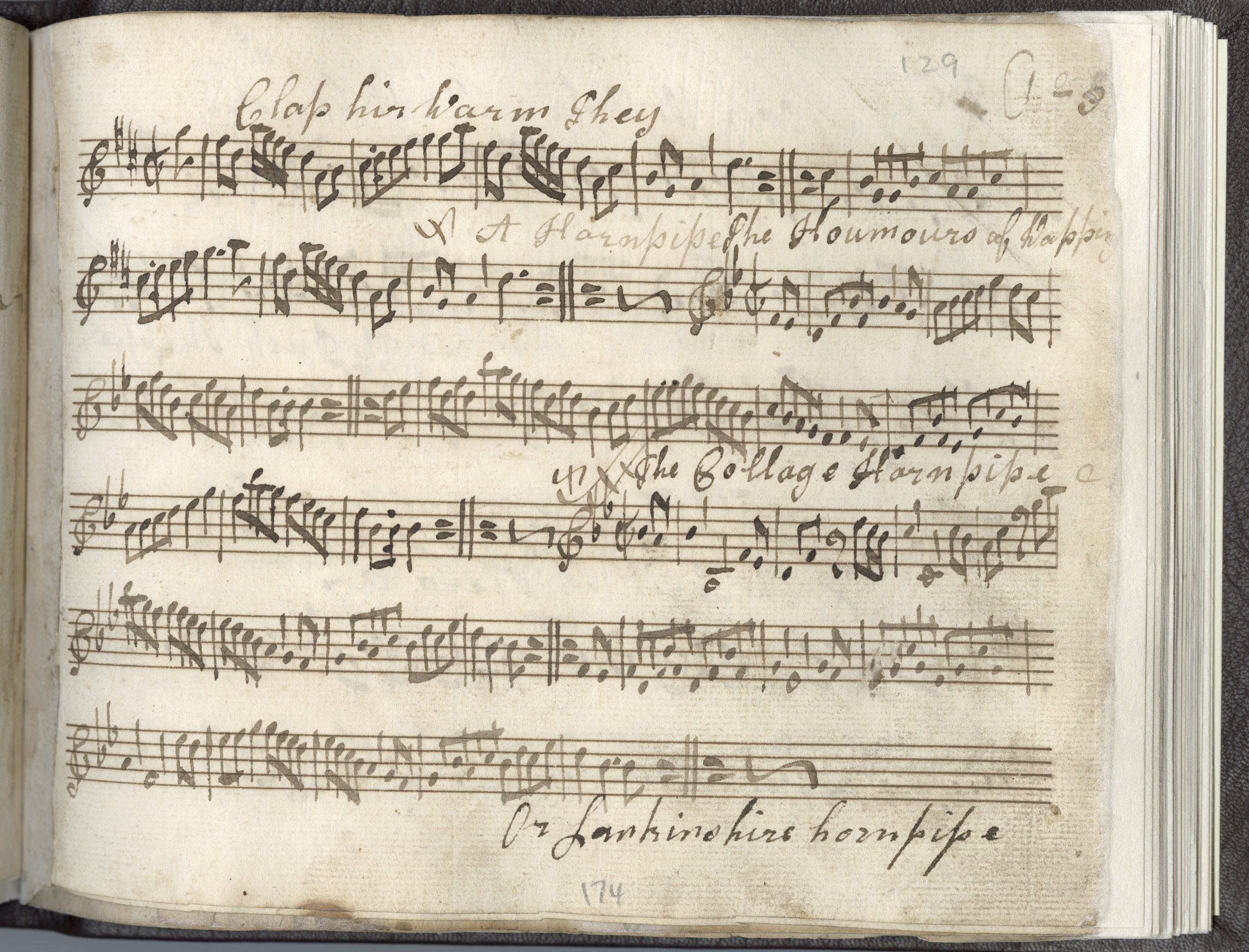
‘College Hornpipe’ from the William Vickers tunebook of 1770, digitized with the kind permission of the Society of Antiquaries of Newcastle upon Tyne.
By searching by tune name – so ‘College Hornpipe’ – we discover that there are over 40 other sources already recorded in the RISM database, including manuscripts catalogued during the Music, Heritage, Place project showing the tune to have been popular and circulating widely in the early 19th century with sources originating in Surrey and Berkshire as well as Northumberland. We also find information about the sources that contain this hornpipe: where the source is, how many folios it has, its dimensions, provenance details and the full contents of the book with the scoring and opening incipits of each tune. All this allows us to start building up a picture of where and when individual tunes were circulating – helping us to reconstruct the soundscape of people in past centuries across England.
What are we learning about Northumberland?
By excavating the musical holdings of England’s county record offices, we are able to unearth broad patterns of musical learning, circulation and communities of music-makers across multiple counties. Northumberland’s earliest music source is ideal for demonstrating all these patterns. The late 17th-century tune book of Newcastle hostman Henry Atkinson – the hostmen being the company of merchants who had a monopoly of the town’s booming coal trade. This manuscript, compiled in the 1690s, embodies a rich and complicated story of musical learning, engagement and circulation with the individuality of Atkinson’s personal compilation of tunes showing similarities with other such instrumental tune books of the period: that is, a mixture of local and regional tunes (‘Gingling Geordie’, ‘Lass in the North country’), tunes from London theatres (Purcell’s ‘How blest are shepherds’ from King Arthur), the copying of tunes from contemporary publications and nationally popular and widespread tunes associated with broadside ballads and country dancing (‘Greensleeves’).
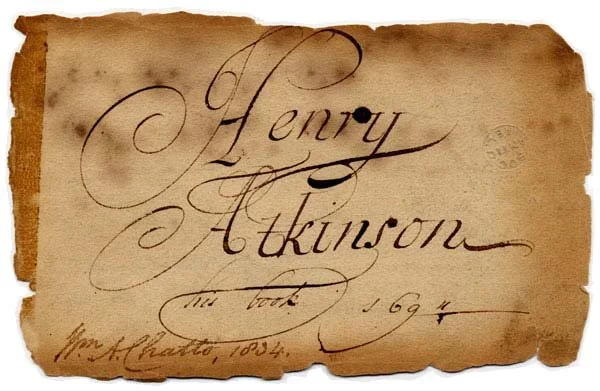
Title-page of Atkinson’s tunebook, taken from FARNE where it is digitized with the kind permission of the Society of Antiquaries of Newcastle upon Tyne.
Atkinson’s book also contains handwritten pedagogical notes that represent Atkinson’s journey of musical learning, with names of the notes given with sol fa notation helping with pitch relationships. The tune book is complicated in its compilation: tunes are written in multiple hands which appear throughout the book suggesting that Atkinson shared his book with family members, friends and colleagues over a period of time.
Atkinson’s book serves as an early source depicting the sorts of patterns that are found in many of the later music books in the Society of Antiquaries’ collection at Northumberland Archives. Winlaton-born chain maker, Isaac Aydon, compiled a tune book around 1836 mixing local tunes with nationally popular tunes. Thanks to research by project volunteer Molly Jervis, we know it contains local tunes such as ‘Wearmouth Lasses’ alongside ‘God save the King’, Thomas Arne’s ‘Rule Britannia’ and Weber’s ‘Huntsmen’s Chorus’ from his opera Der Freischütz which received its London premiere only 12 years before the date Aydon gives his book.

Thomas Arne’s ‘Rule Britannia’ in Aydon’s tune book taken from archive.org where it is digitized with the kind permission of the Society of Antiquaries of Newcastle upon Tyne.
The late 18th-century tune book inscribed the ‘Revd Peter Macnee Minister Great Bavington’ is undoubtedly a personal compilation rather than music serving the Presbyterian church erected there in 1725. Inside this book are signs of musical learning: names of the notes in both the treble and bass clefs, and scales for the violin and flute. There are also some lovely examples of multiple compilation and ownership of music books in the Northumberland collection: a printed violin tutor bound with manuscript pages and dated to the 1820s is full of local tunes such as ‘Aln Banks’, ‘Keel Row’, ‘Hexham Bells’ and ‘Morpeth Rant’. It is inscribed with the names ‘William Hedley of Heatherswick’ and ‘George Wilson of Hepple’, just a few miles from each other. This book is compiled from several hands, demonstrating the sharing and compilation of music books between members of the community in the Rothbury and Otterburn area in the 1820s. Hedley offers the following message, showcasing the personal nature of these music books and their role as objects of memory:
William Hedley is my name and England is my nation
Heatherwick is my dwelling Place & Heaven is my expectation
When I am dead and gone and my bones are all rotten
This will Remember me When I am quite forgotten.
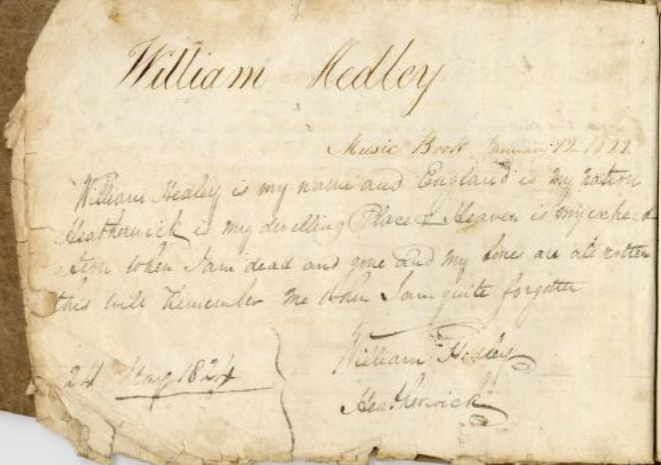
William Hedley’s inscription in the composite volume taken from archive.org where it is digitized with the kind permission of the Society of Antiquaries of Newcastle upon Tyne.
Explore for yourself!
As we finish cataloguing the Northumberland sources, we are also digitizing some items so that you can study or perform the tunes in the comfort of your own home. Why not explore for yourself and have a play?
Click on the sources to go to archive.org or head towards the Resources section on our website:
A big thank you is due to our student volunteers for their support with cataloguing sources. On completion of this work in the coming weeks, we will be sharing our research with the Northumberland Archives team in order to strengthen the archives catalogue descriptions and to link the catalogue records with the RISM entries – 1,644 and counting!
The Music, Heritage, Place: Unlocking the Musical Collections of England’s County Record Offices project is uncovering musical sources in county record offices across England to offer a richer and more decentralised picture of the country’s music heritage. The project is creating RISM catalogue records for musical sources between c.1550 and c.1850 in England’s local archives.
[1]Proceedings of the Society of Antiquaries of Newcastle-upon-Tyne 1/13 (1856), pp. 83-86.