Guest contributor, Dr Amélie Addison (Northumbria University), dives deep into a little-known music source at Northumberland Archives.
Fully digitised and catalogued for the first time during the Music, Heritage, Place project, the William Henderson Music Book (Northumberland Archives, NRO 07231/8) contains Northumbrian and Scots airs, jigs, reels and strathspeys, marches, waltzes, and simplified instrumental versions of popular theatre songs by composers including Tyneside-born William Shield (1748-1829). Deposited among a bundle of fascinating family papers, this volume offers a rare opportunity to examine the music-making of its former owners within the story of their family, career and community.

Paxton House and Garden © The Paxton Trust
The tunebook’s original owner, and compiler of most of its contents – William Henderson (I) – was born near Duns, Berwickshire in 1773. By 1789 Henderson was employed as gardener at Paxton House by Ninian Home – surveyor, plantation owner, and Governor of Grenada from 1792-95, where he was executed in the Fédon uprising against colonial enslavers. While overseas, Home sent regular letters of instruction to Henderson regarding his work in the grounds at Paxton.
The oldest papers in the collection date from around 1794, when Henderson’s son, William (II), was born. William (I) had educated himself in subjects relevant to his role on the estate by transcribing extracts on mathematics, land surveying, carpentry and horticulture from textbooks belonging to his employer. Additional copies made from 1806 onwards suggest he then used these resources to train up his son – but their lives were not all work and no play. The earliest tunes in their music book were probably also copied during this period.
William (II) succeeded his father as gardener before his own son, William (III), was born in 1826. By 1841 Williams (II) and (III) had left Paxton and, after a brief stint at Carham Hall on Tweedside, found work in a clay pipe factory at North Shields, near the mouth of the Tyne. In 1846 they became gardeners at Shawdon Hall, another Northumberland country house, where they kept a log (Northumberland Archives, NRO 7231/7) of their work cultivating vegetables and exotic fruit. This log served as a commonplace book for collating extracts, not only of gardening advice, but humorous dialogues and poetry – revealing something of their character and interests.

In 1851 William (III) was temporarily employed at Axwell Park, estate of the Clavering family in the Derwent valley, before moving to nearby Blaydon where he worked for the family of Joseph Cowen, elected Newcastle’s radical Liberal MP in 1865. William (III) enjoyed both domestic happiness and professional success there, starting a family and winning prizes at local horticultural shows. His employers steadfastly promoted labourers’ rights to education and culture, and Joseph Cowen junior (proprietor of the Newcastle Chronicle who succeeded his father as MP in 1873) shared Henderson’s liking for the tunes of William Shield, campaigning successfully for Shield’s grave in Westminster Abbey to be marked as befitted a national, royal composer.
Statue of Joseph Cowen, Westgate Road/Finkle Street,
Newcastle © Mike Quinn (cc-by-sa/2.0).
The tunebook begun by William (I) at Paxton House can be read as a soundtrack to the Hendersons’ journey. Its quantities of dance tunes, compiled into lists grouped by key in the rear endpapers to facilitate the formation of potential dance ‘sets’, suggest they enjoyed, and perhaps provided instrumental accompaniment for, social dancing. Tunes were transcribed (and later annotated with performance directions, alternative titles and corrections) in several hands and inks, as the book was passed between contributors with varying degrees of musical literacy, down the generations.
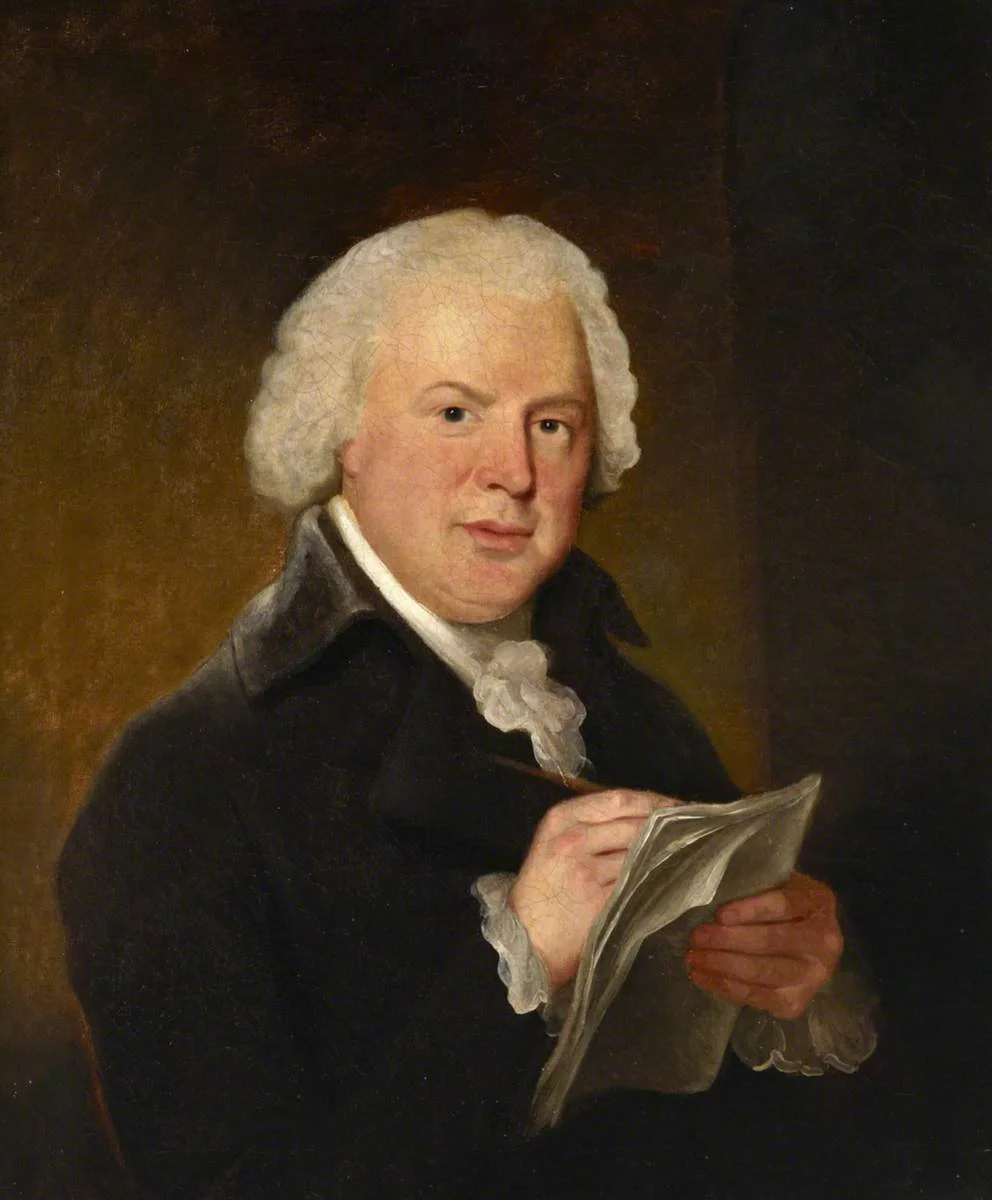
William Shield (1748-1829), portrait by Thomas Hardy (1757-1804) © Royal College of Music.
Several pieces – including Shield songs with discrepancies from printed editions which suggest an amateur arranger – are notated on two treble staves and pitched for a pair of flutes or flageolets, which father and son might have played together. A few melodies carry bowings or fingerings, indicating at least one of them also learned the fiddle. One jig is annotated with the names of William (III)’s wife, while his logbook contains a catalogue poem formed of romantic, even risky puns on flower names; notational errors and local dialect may indicate he adapted or composed these himself. This family were not passive consumers of popular culture: creative engagement with music and words was woven through the fabric of their relationships.
Although William (IV) initially followed the family profession of gardening, by 1901 unemployment had forced him literally underground, into shiftwork at Greenside colliery; yet later papers suggest he still found solace in poetry, in harder times. That the family retained specimens of art and beauty – songs, dances, poems and immense volumes of pressed flowers – alongside training notes and work logs, tells us that their professional labour and cultural recreation were closely intertwined, and equally valued. The survival of a music book among this unique and diverse family archive contributes to a rich, rounded portrait of everyday music-makers who would otherwise have been forgotten.
Amélie Addison has previously written about the Hendersons’ versions of tunes by William Shield in Folk Music Journal (2020, pp. 47-50). A more in-depth article on their history and archive is forthcoming.